Òun a ni là ń gbé láruge
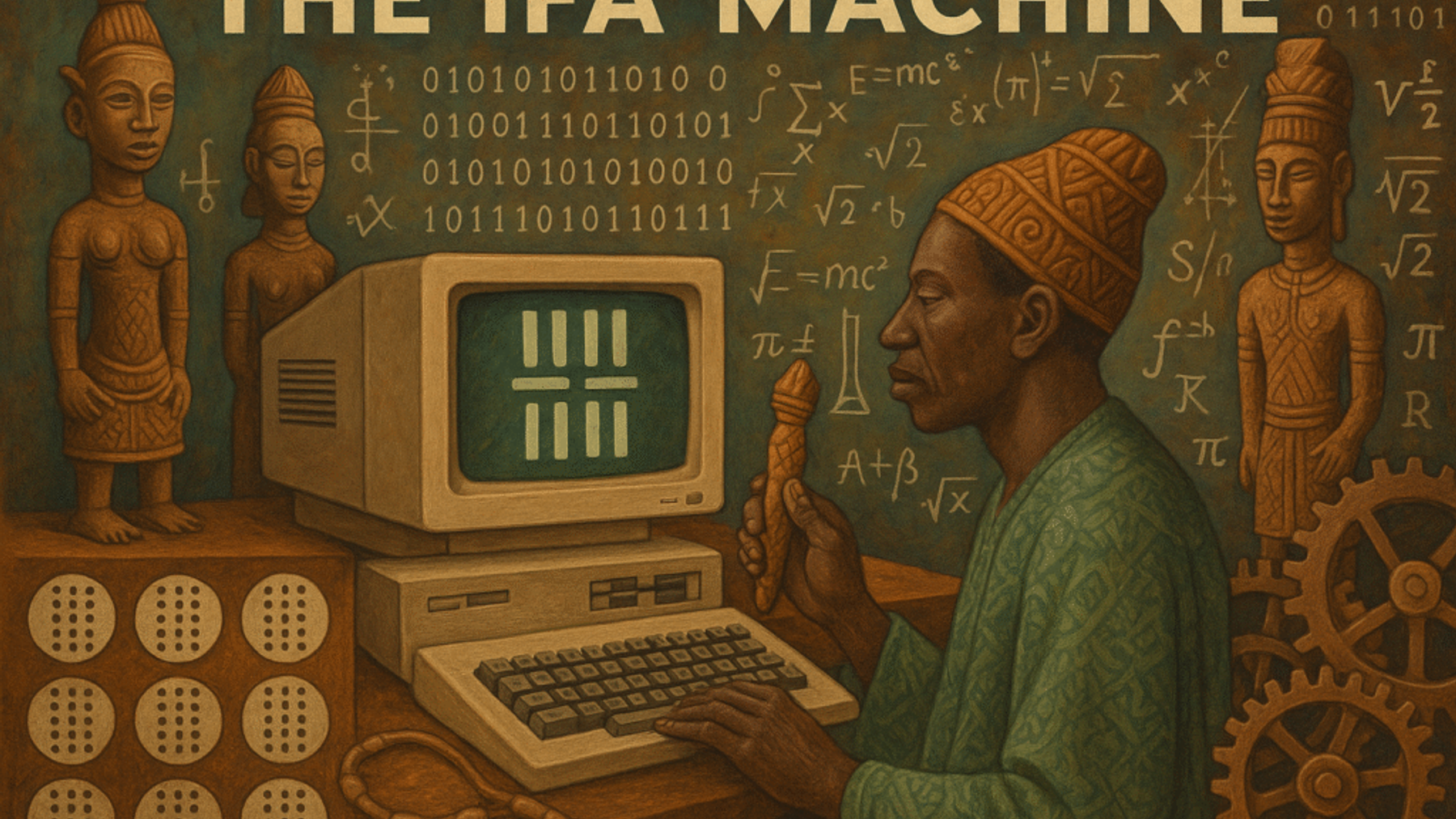
Long before Silicon Valley, before Bletchley Park, before Gottfried Leibniz sat down in 1703 to formalize the binary number system that would eventually power every device you own, there was a babalawo in Yorubaland holding sixteen palm nuts, passing them rapidly between his hands, and recording a mark for what remained.
One nut left in the right hand. Or two.
A single line. Or a double line.
Repeat that eight times, and you have one Odù. There are 256 of them.
If that number sounds familiar, it should. A byte, the basic unit every computer on earth still uses to store a value, holds exactly 256 possible states. The Yoruba got there first, and they got there through a system that wasn't just spiritually profound. It was mathematically exact.
It is tempting to treat this as a poetic coincidence. It isn't. Researchers have gone as far as writing out the Odù as formal matrices, and shown that they satisfy the axioms of an algebraic group under binary addition, the same category of structure that underlies modern cryptography and coding theory. The scholar Ron Eglash spent years documenting this and related African systems in his book African Fractals, describing Ifá as one of the most advanced indigenous mathematical frameworks in the world: combinatorial reasoning, executed with total rigor, centuries before Europe formalized the same ideas.
Each Odù, once cast, does not stand alone. It carries with it a body of oral literature, the ẹsẹ, verses of precedent, consequence, and guidance that the babalawo interprets for the person in front of him. Strip away the language of divination and you are left with something a computer scientist would recognize immediately: a binary input, a lookup process across a fixed set of 256 outputs, and an interpretation layer that turns raw signal into meaning.
That is, structurally, an algorithm. It is also, unmistakably, ours.
Why we believe this matters now
We don't tell this story to relitigate history. We tell it because of what it implies about the present.
For too long, the dominant story about Africa and technology has been a story of catching up. Importing tools built elsewhere. Translating, quite literally, into the assumptions of somewhere else. That story has never been the whole truth, and Ifá is proof of it. Nigeria, and Yorubaland specifically, did not arrive late to computation. In some real sense, we were early.
At Reedapt, that history is not a footnote we reach for when it's convenient. It's the frame we build inside.
Reedapt exists because African stories, in African languages, keep hitting the same wall the moment they try to leave home: dialogue. A film shot in Yoruba, a sermon delivered in Yoruba, a piece of music or teaching rooted in a specific tongue, all of it tends to stop at the border of who already speaks that language, or gets flattened into subtitles that audiences skim rather than feel.
We built Reedapt Dub to remove that wall. It's AI dubbing infrastructure, purpose-built for African languages, that lets a story keep its voice, its actor's tone, its cadence, while crossing into French, Portuguese, English, and beyond. We've already taken Yoruba-language film into French for a Nigerian production studio, and watched that content reach audiences it never could have reached as a subtitled file sitting in a regional catalogue.
That is the throughline we care about: the same people whose ancestors encoded 256 states into a system of palm nuts and oral verse are now the ones building the AI infrastructure carrying African language and African story to the rest of the world. Not asking for a seat at the table late. Continuing something that started early.
Where we believe this goes
We don't think Nigeria's, or Africa's, relationship to technology should be defined by adoption. We think it should be defined by authorship, the way it already was once, long before anyone called it computation.
Reedapt is one small piece of that. A translation company on the surface, infrastructure underneath, and a bet, underneath that, that the continent that quietly built one of the world's earliest binary systems has every right to help build what comes next.
Òun a ni là ń gbé láruge.
This is what we carry forward.
Reedapt is an AI multilingual language infrastructure company building the tools that let African stories travel in their own voice, to every language. "Your content. Every language."